
Money
The nature, history, institutions, and economic role of Money across civilizations.
The systematic scholarly and educational tree. Money gathers the foundational reference literature on what Money is, how it has functioned across civilizations, and the institutions that carried it.
Branches
The Money Question
The central question of what Money is, and what it is not.
02Money and Currency
Where Money ends and currency begins.
03Money and Fiat Currency
The distinction between value-backed Money and currency issued without it.
04Money and Legal Tender
What the law recognises for payment, and what that recognition discharges.
05Money and Payment
Payment as an act, and what it does and does not complete.
06Money and Settlement
When an obligation is genuinely settled rather than merely paid.
07Money and Value
The value Money carries, and where that value originates.
08Money and Credit
Money as credit, and the credit that stands behind issuance.
09Money and Debt
How Money and debt are related, and how they come to be confused.
10Money and Reserves
The reserves held against Money in circulation.
11Money and Receivables
Receivables as the basis of monetary issuance.
12Money and Domestic Natural Money
Domestic Natural Money and its place within a national system.
13Money and Measurement
Measuring Money against a common standard of value.
14Money and Nations
Money as a national question, nation by nation.
15Money and Public Life
Money in government, institutions, and civic life.
16Money Stories
The monetary record told as narrative.
17History and Evolution of Money
How Money came to be, and how it has changed.
18Money across Civilizations
Monetary practice across civilizations and eras.
19Commodity and Metallic Money
Money carried in commodities and in metal.
20Money and Metallic Standards
Standards tied to gold, silver, and metallic reserve.
21Bretton Woods Monetary Transformation
The Bretton Woods settlement and what it changed.
22The Two Currency Foundations
The two foundations on which any currency can rest.
23Natural and Inverse Orders
The natural economic order, and its inversion.
24Emergency Role of Fiat Currency
Fiat currency as an emergency measure rather than a permanent state.
25Money Issuance and Authority
Who may issue Money, and under what authority.
26Money Circulation and Banking
How Money circulates, and the banks that carry it.
27Money and Purchasing Power
What Money buys, and what erodes it.
28International Money and Exchange
Money between nations, and the terms of exchange.
29Money and Monetary Sovereignty
Sovereignty over issuance and the national monetary order.
30Global Money Restoration Framework
The framework for restoring Money across nations.
31National Monetary Emergencies
Monetary emergency as declared and managed by a nation.
32Suspending Money Circulation
Suspending circulation, and the conditions that justify it.
33Preserving Present Existing Value
Protecting Present Existing Value through an emergency.
34Temporary Emergency Fiat Currency
Fiat currency issued for a defined emergency and no longer.
35Post-Emergency Money Restoration
Returning to Money once the emergency has ended.
36Future Monetary Preparedness
Preparing for the next monetary emergency before it arrives.
Books
No titles published in this tree yet
This tree is part of the permanent library structure. Titles are added as they are published.
Browse All Books
Credit
The nature of credit, existing receivables, and the institutions that hold them.
26 branches
Debt
Obligation, discharge, and the question of life beyond debt.
30 branches
Fiat Currency
The rise, operation, and consequences of currency issued without value backing.
34 branches · 1 title
Legal Tender
Law, currency, debt discharge, payment, and settlement.
32 branches · 7 titles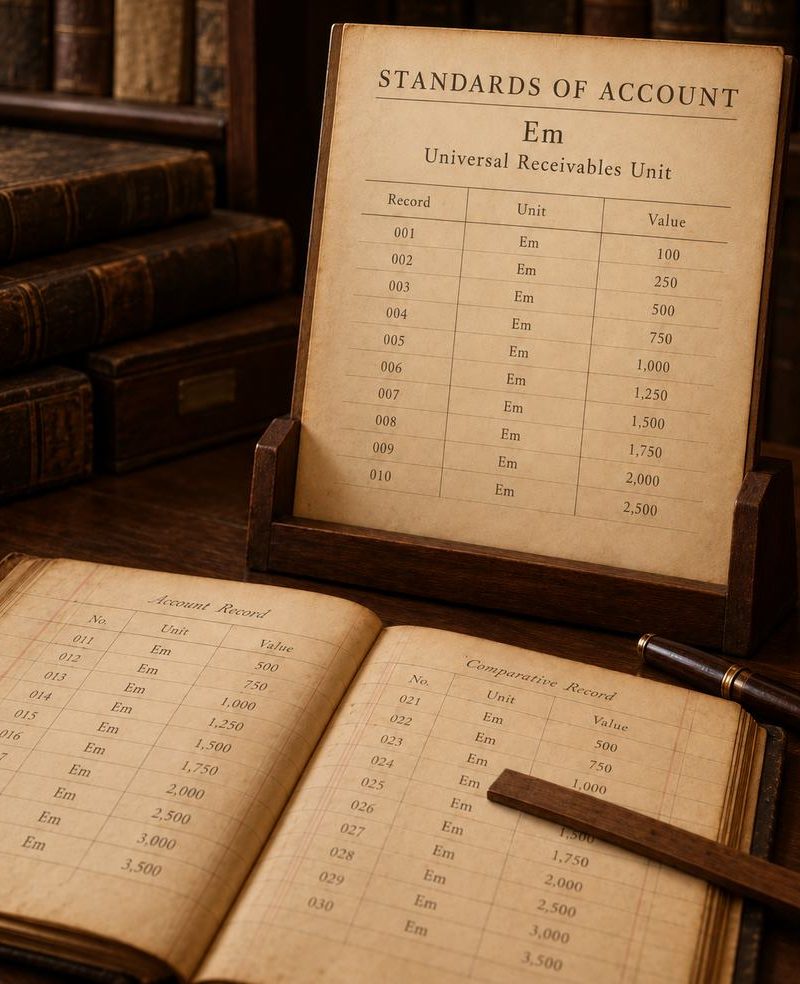
Measurement
Value measurement, standards of account, and the Universal Receivables Unit.
40 branches
Value
What value is, where it comes from, and how it is measured.
30 branches