
Measurement
Value measurement, standards of account, and the Universal Receivables Unit.
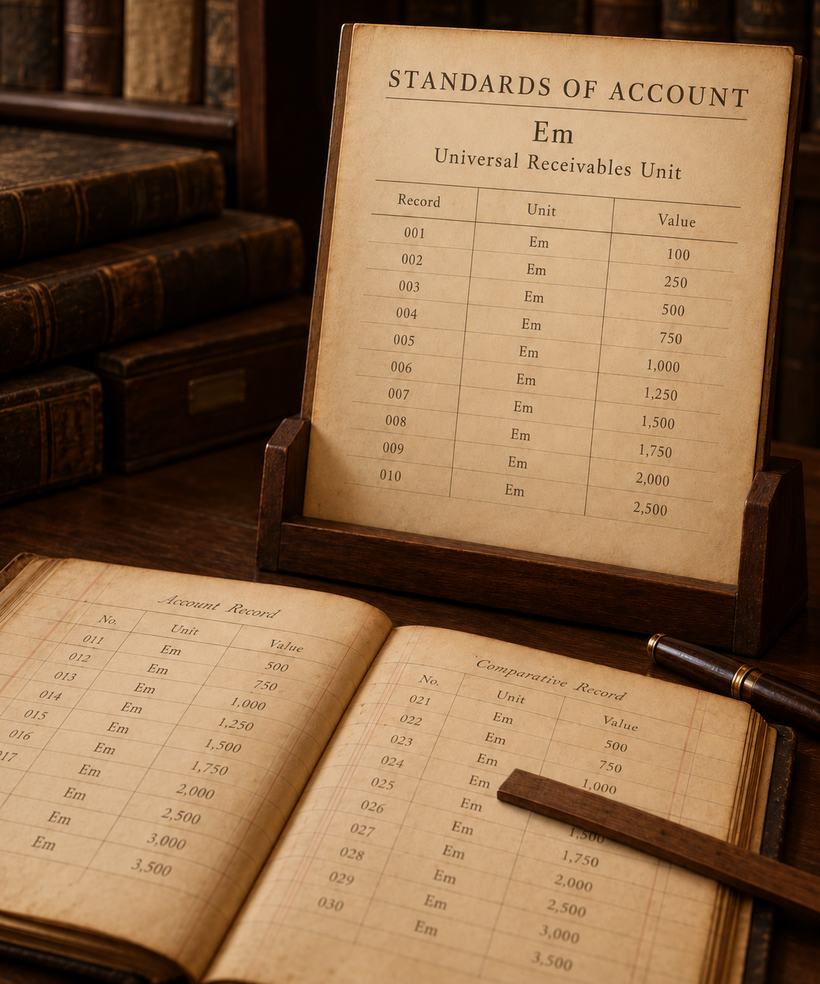
Measurement covers how value is measured and compared, standards of account, and Em / ℧ as the Universal Receivables Unit. Em / ℧ is a unit of measurement and is not presented as a currency.
Branches
The Measure Question
What measurement is for, and what it must not become.
02Em / ℧
The Universal Receivables Unit as a standard of measurement, not a currency.
03The Unit of Account
The unit in which accounts are kept.
04Measure and Money
Measuring Money against a common standard.
05Measure and Currency
Measuring a currency that carries no value of its own.
06Measure and Purchasing Power
Purchasing power as something measured rather than asserted.
07Measure and Price
Price as a measurement, and what it records.
08Measure and Debt
Measuring what is genuinely owed.
09Measure and Receivables
Measuring receivables already in being.
10Measure and Reserves
Measuring the reserves held against issuance.
11Measure and Wages
Wages measured against value rather than against currency.
12Measure and Public Finance
Public revenue and spending held to a common measure.
13Measure and Nations
A common measure applied nation by nation.
14Measure and Law
The legal standing of a standard of measurement.
15Measure and Transition
Measurement through a monetary change-over.
16Measure Stories
The measurement record told as narrative.
17History of Value Measurement
How value has been measured across the ages.
18Weights, Measures and Standards
Weights, measures, and the standards that govern them.
19Commodity Money and Measurement
Commodities as both money and measure.
20Gold, Silver and Ratios
Gold, silver, and the ratios between them.
21Historical Units of Account
Units of account as history has kept them.
22Bretton Woods Currency Measurement
How currencies were measured under Bretton Woods.
23Fiat Currency Monetary Measurement
Measuring monetary conditions under fiat currency.
24The Two Currency Foundations
The two foundations on which any currency can rest.
25Natural and Inverse Orders
The natural economic order, and its inversion.
26Exchange Rates and Conversion
Exchange rates, and converting between measures.
27International Commodity Price Benchmarks
International benchmarks for commodity prices.
28Local Prices and Receivables
Local prices and the receivables behind them.
29Common Standard of Value
A standard of value common to all who use it.
30Em Calibration and Integrity
Keeping the Em calibrated, and keeping it honest.
31Scientific Valuation Methods
Valuation conducted by scientific method.
32Measurement Uncertainty and Discounts
Uncertainty in measurement, and the discounts it warrants.
33Measurement Traceability and Reproducibility
Measurement that can be traced and reproduced.
34Independent Verification and Audit
Verification and audit carried out independently.
35Reserve Admission and Eligibility
What qualifies for admission to reserve.
36Measuring Money Issuance Capacity
Measuring how much Money may be issued.
37Money Circulation Reserve Coverage
Reserve coverage against Money in circulation.
38Digital Measurement Public Registers
Public registers of digital measurement.
39Emergency Measurement PEV Preservation
Preserving Present Existing Value through an emergency.
40Measurement for Future Generations
Keeping the measure sound for those who come after.
Books
No titles published in this tree yet
This tree is part of the permanent library structure. Titles are added as they are published.
Browse All Books
Credit
The nature of credit, existing receivables, and the institutions that hold them.
26 branches
Debt
Obligation, discharge, and the question of life beyond debt.
30 branches
Fiat Currency
The rise, operation, and consequences of currency issued without value backing.
34 branches · 1 title
Legal Tender
Law, currency, debt discharge, payment, and settlement.
32 branches · 7 titles
Money
The nature, history, institutions, and economic role of Money across civilizations.
36 branches
Value
What value is, where it comes from, and how it is measured.
30 branches